How Long Until 4PM? A Complete Guide to Calculating Time Until Any Hour
To find out how long until 4PM, subtract the current time from 4:00 PM (16:00 in 24-hour format). If it’s 1:15 PM right now, you have 2 hours and 45 minutes to go. If it’s already past 4PM, you’re looking at the wait until 4PM tomorrow instead.
That’s the short version. But there’s more to this simple-sounding question than meets the eye — time zones, AM/PM confusion, and mental math errors trip people up more often than you’d think. Let’s break it all down.
The Direct Verdict: How to Get Your Answer Right Now

If you’re asking “how long until 4pm,” you’re almost always in one of three situations:
- You know the current time and want a quick mental calculation
- You’re planning something (a meeting, a deadline, the end of your workday) and need to know the gap
- You’re counting down to something specific happening at 4PM
Here’s the fastest way to solve it without a calculator:
- Convert 4PM to 24-hour time: 16:00
- Subtract the current hour and minute from 16:00
- If your current time is already past 16:00, add 24 hours to get tomorrow’s countdown
For example, if it’s currently 11:40 AM, you’d calculate 16:00 minus 11:40, which gives you 4 hours and 20 minutes.
Why People Search “How Long Until 4PM” So Often
This might seem like an oddly specific question, but it’s actually one of the most commonly searched time-related queries online. There’s a reason for that.
4PM sits at a psychologically loaded point in the day for a lot of people. It’s close enough to “quitting time” that it feels like the finish line is in sight, but far enough away that the wait can drag. Office workers check it obsessively during the last stretch of a shift. Parents track it because it’s a common school pickup or after-school activity time. Students watch the clock because 4PM often marks the end of a study block or the start of free time.
There’s also a practical side. A lot of appointments, deliveries, deadlines, and broadcasts are scheduled for 4PM specifically because it splits the afternoon cleanly. Package tracking notifications, webinar start times, and “we’ll call you by 4PM” promises all generate the same countdown instinct.
And honestly, sometimes people just don’t want to do the subtraction themselves. Mental math under pressure — especially when you’re tired, bored, or anxious about a deadline — gets surprisingly unreliable. That’s where a quick reference (or a countdown tool) comes in handy.
Step-by-Step: How to Calculate Time Until 4PM
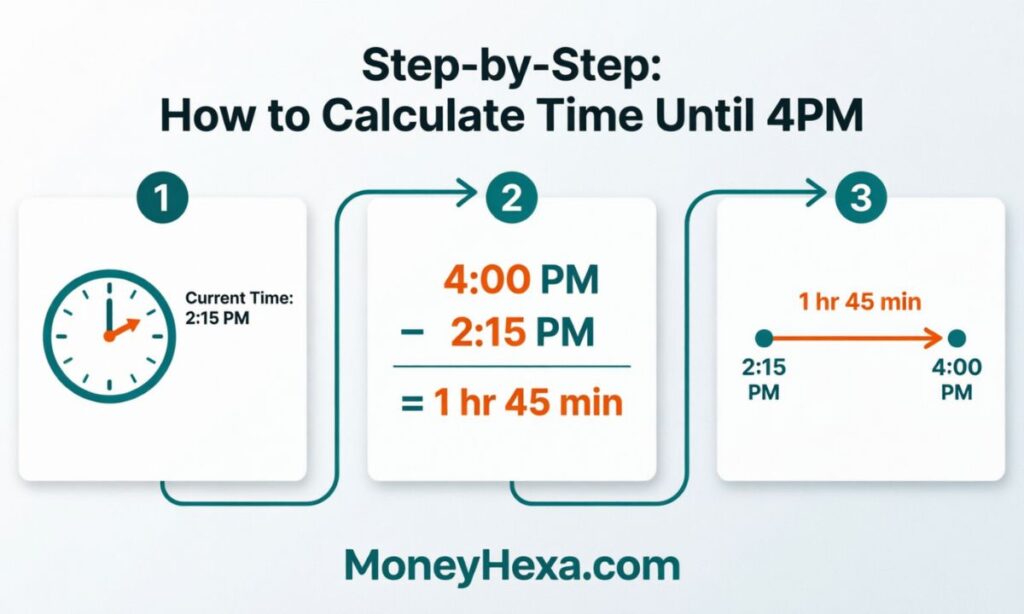
Let’s walk through the actual method so you can do this in your head every time, not just look it up.
Step 1: Identify the current time and convert to 24-hour format if needed
If you’re using a 12-hour clock, keep track of whether you’re in the AM or PM. This is the single biggest source of errors. “It’s 4 o’clock” means nothing without knowing which 4 o’clock you’re talking about.
Step 2: Set your target as 16:00
4PM is always 16:00 in 24-hour (military) time. Locking this in mentally removes the AM/PM guesswork entirely.
Step 3: Subtract hours first, then minutes
Work for a whole hour before you touch the minutes. It’s much easier to subtract 16 minus 9 (hours) and then deal with the minute remainder separately than to try to do it all in one messy step.
Step 4: Adjust for the minute difference
If your current minutes are higher than zero, you’ll usually need to “borrow” from the hour. For example, going from 9:20 to 16:00 isn’t a clean subtraction — you calculate it as 6 hours and 40 minutes, not 7 hours minus 20 minutes.
Step 5: Check if 4PM has already passed
If it’s currently 6PM, you’re not counting down to a time in the past. You’re counting forward to 4PM the next day, which means adding the remaining hours of today plus the hours from midnight to 4PM tomorrow.
Time Until 4PM: Quick Reference Table
Here’s a table you can scan instead of doing the math yourself:
| Current Time | Time Until 4PM |
| 6:00 AM | 10 hours 0 minutes |
| 8:00 AM | 8 hours 0 minutes |
| 9:15 AM | 6 hours 45 minutes |
| 10:30 AM | 5 hours 30 minutes |
| 11:45 AM | 4 hours 15 minutes |
| 12:00 PM (Noon) | 4 hours 0 minutes |
| 1:00 PM | 3 hours 0 minutes |
| 2:20 PM | 1 hour 40 minutes |
| 3:00 PM | 1 hour 0 minutes |
| 3:45 PM | 15 minutes |
| 3:59 PM | 1 minute |
If 4PM Has Already Passed Today
| Current Time | Time Until 4PM (Tomorrow) |
| 4:30 PM | 23 hours 30 minutes |
| 6:00 PM | 22 hours 0 minutes |
| 9:00 PM | 19 hours 0 minutes |
| 11:59 PM | 16 hours 1 minute |
| 12:15 AM | 15 hours 45 minutes |
Real-World Scenarios Where This Calculation Matters

Work and office deadlines
A huge number of workplace deadlines default to “end of day” or “by 4PM,” especially in industries where teams need buffer time before 5PM to review submissions. If a project is due at 4PM and it’s currently 1:30 PM, you’re working with a 2.5-hour window — tight, but workable if you plan it out.
School pickup and after-school schedules
Parents dealing with staggered pickup times, sports practices ending, or tutoring sessions wrapping up at 4PM rely on this calculation constantly, often while multitasking, which is exactly when mental math mistakes happen.
Flight, train, or bus departures
If your departure is scheduled for 4PM and you’re figuring out how much buffer time you have for traffic, security lines, or last-minute packing, getting this number right actually matters — not just as a curiosity.
Live events and broadcasts
Webinars, livestreams, product launches, and sports broadcasts frequently use 4PM as a start time because it works across a reasonable range of time zones for a single-country or regional audience.
Cooking and meal prep
If something needs to be ready by 4PM — a slow cooker recipe, a dish that needs to rest, bread that needs to proof — knowing exactly how much time you have left changes what you’re able to attempt.
Common Mistakes and Misconceptions
Confusing 4PM with 4AM. This sounds obvious, but it happens constantly, especially in text messages or quickly typed notes where “4” gets used without specifying AM or PM.
Forgetting that “16:00” is 4PM, not 6PM. People who aren’t used to 24-hour time sometimes assume the hour number transfers directly, which leads to a full two-hour miscalculation.
Not accounting for time zones. If you’re coordinating with someone in a different time zone and they say “let’s talk at 4PM,” you need to clarify whose 4PM they mean. This is one of the most common sources of missed calls and meetings.
Miscounting across the noon boundary. Going from morning to afternoon trips people up because the “12” resets in a way that doesn’t follow normal subtraction logic. Treating noon as “12,” not “0,” keeps this clean.
Ignoring daylight saving time shifts. On the days clocks change, “how long until 4PM” isn’t a simple subtraction — you either gain or lose an hour depending on the direction of the shift.
Rounding too aggressively. Saying “about 4 hours” when it’s actually 3 hours and 12 minutes can matter more than people think, especially for travel or deadline planning.
Also Read These Time Measurements:
“How Long Until 11:30: The Simple Way To Count Down To Any 11:30“
“How Long Until 1:40? Your Quick Time Calculator Guide“
Related Calculations You Might Also Need
Since 4PM isn’t the only hour people count down to, here are similar calculations worth knowing:
- How long until noon — useful for lunch planning and half-day deadlines
- How long until 5PM — the classic end-of-workday countdown
- How long until midnight — common for deadline-based tasks and countdown events
- How long until 3PM — often tied to school dismissal times
- How many hours in a workday — helpful for productivity and time-blocking
- Time zone converters — essential when 4PM means something different depending on location
If you’re someone who deals with this kind of math regularly — scheduling, coordinating across time zones, managing deadlines — it’s worth bookmarking a simple time-zone converter and a countdown tool so you’re not doing this manually every single day.
Conclusion
Figuring out how long until 4PM comes down to one simple move: treat 4PM as 16:00, subtract your current time from it, and adjust if you’ve already passed that hour today. It’s a small calculation, but it shows up constantly — in work deadlines, school pickups, travel planning, and everyday scheduling.
Once you get comfortable converting to 24-hour time and handling the borrow-a-minute logic, you’ll be able to do this instantly without reaching for a calculator or an app.

William Johnson is a dedicated writer and measurement enthusiast at moneyhexa.com. He shares accurate, simple, and practical insights about measurements, dimensions, sizes, and everyday comparisons. With a passion for making complex topics easy to understand, William helps readers discover useful information through clear explanations, research-based content, and engaging guides designed for learners, curious minds, and everyday users.