How Long Until 10 PM? Quick Time Calculator and Easy Guide
You’re staring at the clock, counting down to something happening at 10 PM. Maybe it’s a movie premiere, a bedtime deadline for the kids, a flight, or the end of your shift.
Whatever it is, you want one thing: the exact number of hours and minutes left. This guide gives you that answer fast, then walks you through the simple math so you can calculate it yourself anytime, from any starting point.
Quick Answer
The time left until 10 PM depends entirely on what time it is right now. To find it, subtract your current time from 10:00 PM using a 24 hour format.
Here’s the basic formula:
22:00 minus current time (in 24 hour format) equals hours and minutes remaining
For example, if it’s currently 3:00 PM (15:00), you subtract 15:00 from 22:00, which gives you 7 hours. If it’s 6:45 PM (18:45), the gap is 3 hours and 15 minutes. Below, we break this down into a table so you don’t have to do the math in your head.
Time Remaining Until 10 PM: Quick Reference Table
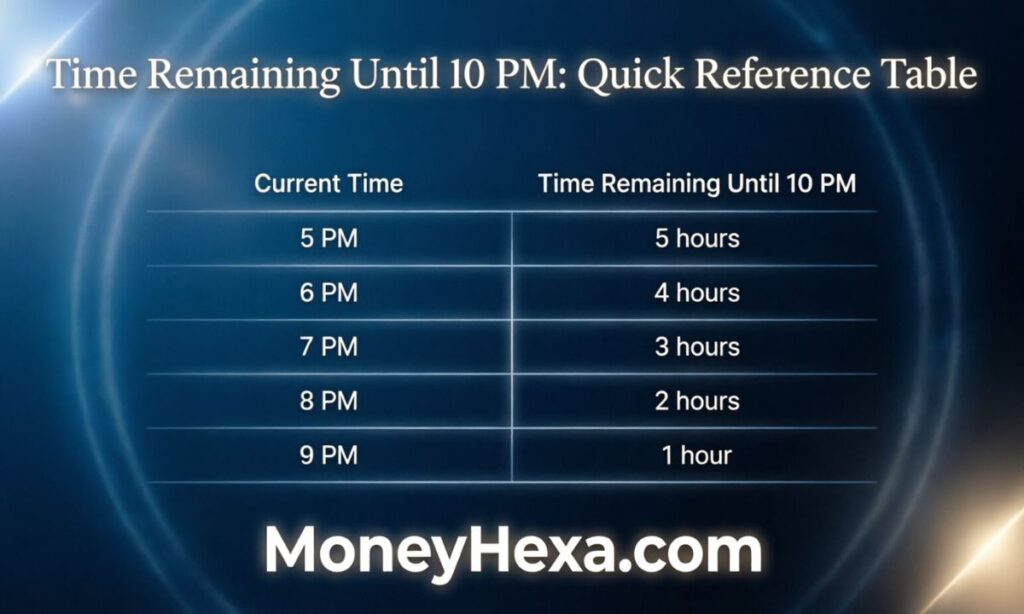
Use this table to check how much time is left based on common starting points throughout the day.
| Current Time | Time Until 10 PM |
| 6:00 AM | 16 hours |
| 9:00 AM | 13 hours |
| 12:00 PM (Noon) | 10 hours |
| 2:30 PM | 7 hours 30 minutes |
| 4:15 PM | 5 hours 45 minutes |
| 6:00 PM | 4 hours |
| 7:30 PM | 2 hours 30 minutes |
| 8:45 PM | 1 hour 15 minutes |
| 9:00 PM | 1 hour |
| 9:50 PM | 10 minutes |
This table covers the most common check in points, but you won’t always land on a neat time like these. That’s where knowing the actual calculation method comes in handy.
How to Calculate Time Until 10 PM (Step by Step)
Working out how long until 10 PM is simple once you switch to 24 hour time. Here’s the process broken into clear steps.
Step 1: Convert 10 PM to 24 Hour Time
10 PM becomes 22:00 in 24 hour format. This is your fixed target point for every calculation.
Step 2: Convert Your Current Time to 24 Hour Format
If it’s currently a PM time, add 12 to the hour (unless it’s already 12 PM, which stays as 12:00). So 4:00 PM becomes 16:00, and 8:30 PM becomes 20:30. Morning times before noon stay the same, so 9:15 AM is just 09:15.
Step 3: Subtract Your Current Time From 22:00
Line up the hours and minutes separately. Subtract the minutes first, then the hours.
For example: it’s 5:20 PM, which is 17:20 in 24 hour time.
- 22:00 minus 17:20
- Borrow an hour: 21:60 minus 17:20
- Hours: 21 minus 17 equals 4
- Minutes: 60 minus 20 equals 40
- Total: 4 hours and 40 minutes until 10 PM
Step 4: Double Check With a Simpler Trick
If the math feels like too much, count in chunks. Figure out how many full hours are left first, then adjust for the leftover minutes. Most people find this quicker than doing formal subtraction.
Common Mistakes and Misconceptions

A lot of people trip up on this calculation, and it’s usually for the same handful of reasons.
Mixing up AM and PM. This is the biggest one. Someone checks the clock, sees “10:00,” and assumes it means 10 PM when it’s actually 10 AM the next morning. Always confirm which 10 o’clock you’re aiming for.
Forgetting midnight resets the clock. If it’s currently 11:00 PM and you’re counting toward 10 PM, you’re actually counting toward tomorrow’s 10 PM, which is 23 hours away, not negative one hour.
Skipping the 24 hour conversion. Doing subtraction directly in 12 hour format (like trying to subtract “6:30 PM” from “10:00 PM” without converting) leads to errors, especially around the noon and midnight marks.
Rounding too early. If your current time is 2:47 PM, don’t round it to 3:00 PM before calculating. That small rounding adds up and throws off your final answer by several minutes.
Ignoring time zones. If you’re coordinating with someone in another time zone and asking “how long until 10 PM,” you both need to agree on whose 10 PM you mean.
Why People Search “How Long Until 10 PM”

This search shows up more often than you’d think, and the reasons behind it are pretty relatable.
- Bedtime routines. Parents track this constantly, especially when trying to get kids settled before a set hour.
- Work shifts. Anyone on an evening shift that ends at 10 PM watches the clock closer as the night goes on.
- Events and shows. Concerts, movie screenings, and streaming premieres often start or end around 10 PM, so people count down to catch them live.
- Curfews. Teens and college students calculating how much time they have left before a curfew hits.
- Fasting windows. People doing intermittent fasting or religious fasting (like during Ramadan) often track their eating window against a 10 PM cutoff.
- Flight and travel schedules. Boarding times, layovers, and arrival windows frequently line up with evening hours like 10 PM.
Basically, 10 PM sits at a point in the day where a lot of transitions happen. Work ends, kids go to bed, shows start, and curfews kick in. That makes it a natural clock marker people plan around.
Real World Example Scenarios
Let’s look at a few practical situations where this calculation actually matters.
Scenario 1: Planning a Night Shift
Sara starts her shift at 3:00 PM and finishes at 10:00 PM. At 6:15 PM, she checks how much longer she has left. Using the formula: 22:00 minus 18:15 equals 3 hours and 45 minutes. She’s a little over halfway through.
Scenario 2: Countdown to a Movie Premiere
A midnight release event is building up, but the doors open at 10 PM for early seating. It’s currently 4:40 PM. That’s 22:00 minus 16:40, which equals 5 hours and 20 minutes until doors open.
Scenario 3: Setting a Bedtime Reminder
A parent wants their child in bed by 10 PM sharp. It’s 8:05 PM right now. That leaves 1 hour and 55 minutes to finish dinner, bath time, and story time.
Time Conversion Table: AM/PM to 24 Hour Format
Since converting between 12 hour and 24 hour time trips people up the most, here’s a reference table covering the evening hours most relevant to this calculation.
| 12 Hour Time | 24 Hour Time |
| 12:00 PM (Noon) | 12:00 |
| 1:00 PM | 13:00 |
| 2:00 PM | 14:00 |
| 3:00 PM | 15:00 |
| 4:00 PM | 16:00 |
| 5:00 PM | 17:00 |
| 6:00 PM | 18:00 |
| 7:00 PM | 19:00 |
| 8:00 PM | 20:00 |
| 9:00 PM | 21:00 |
| 10:00 PM | 22:00 |
| 11:00 PM | 23:00 |
| 12:00 AM (Midnight) | 00:00 |
Keep this table bookmarked. It removes the guesswork every time you need to calculate a time difference involving evening hours.
Also Read These Articles:
“How Long Until 11 AM? The Simple Way to Calculate It Every Time“
“How Long Until 1:40? Your Quick Time Calculator Guide“
Related Time Calculations People Also Search For
If you found this guide useful, you might also want to work out these related time gaps:
- How long until 9 PM
- How long until midnight
- How long until 6 AM
- Hours between 2 PM and 10 PM
- How many hours until tomorrow
- Time left until end of day
- Countdown to a specific date and time
Each of these follows the same core method: convert to 24 hour time, subtract, and adjust for minutes.
Conclusion
Figuring out how long until 10 PM comes down to one simple habit: convert the current time to 24 hour format, then subtract it from 22:00. Once that clicks, you can do this math in your head within seconds, no calculator needed.
Whether you’re timing a work shift, a bedtime, or a countdown to your favorite show, this method works every single time.

William Johnson is a dedicated writer and measurement enthusiast at moneyhexa.com. He shares accurate, simple, and practical insights about measurements, dimensions, sizes, and everyday comparisons. With a passion for making complex topics easy to understand, William helps readers discover useful information through clear explanations, research-based content, and engaging guides designed for learners, curious minds, and everyday users.