How Long Until 11 AM? The Simple Way to Calculate It Every Time
You glance at the clock, you’ve got somewhere to be at 11 AM, and your brain just refuses to do the subtraction. Sound familiar? Whether you’re timing a meeting, counting down to a flight, or just trying to figure out if you have time for a shower, working out how long until 11 AM comes up more often than you’d think.
This guide breaks it down completely — the math, the shortcuts, real examples, and the mistakes almost everyone makes when doing time calculations by hand.
Quick Answer
The time remaining until 11 AM depends entirely on your current time. Here’s the fast method:
- If it’s before 11 AM today: Subtract your current time from 11:00.
- If it’s after 11 AM: You’re calculating time until 11 AM tomorrow, so subtract your current time from 24:00 (midnight), then add 11 hours.
For example, if it’s currently 8:15 AM, the time until 11 AM is 2 hours and 45 minutes. If it’s 3:40 PM, you’re looking at 19 hours and 20 minutes until 11 AM tomorrow.
There’s no single fixed answer — it changes minute by minute — but the formula below never fails.
Step-by-Step: How to Calculate Time Until 11 AM
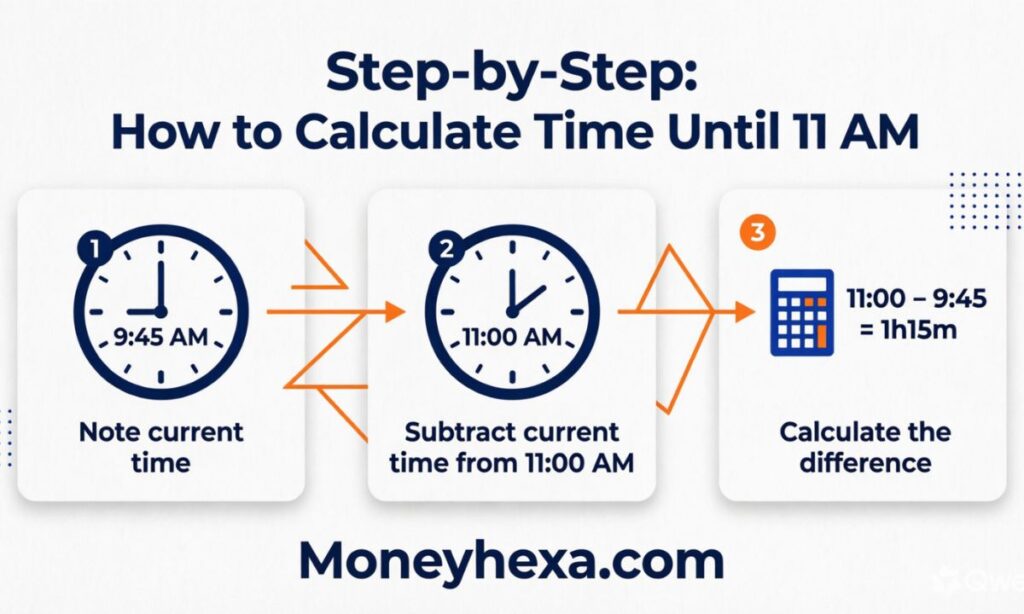
Here’s the exact process, broken into simple steps you can do in your head or on paper.
Step 1: Check Your Current Time
Note the current hour and minute, and whether it’s AM or PM. This matters more than people expect — 11:00 means nothing until you know if you’re counting from 9 AM or 9 PM.
Step 2: Determine If 11 AM Has Already Passed
- If the current time is earlier than 11:00 AM today, you’re counting forward to today’s 11 AM.
- If the current time is later than 11:00 AM, the next 11 AM is tomorrow, so you’re counting through midnight.
Step 3: Do the Subtraction
Scenario A — Before 11 AM today: Subtract your current time from 11:00.
11:00 – Current Time = Time Remaining
Scenario B — After 11 AM today: Add the time left until midnight to the 11 hours that follow midnight.
(24:00 – Current Time) + 11:00 = Time Remaining
Step 4: Convert Minutes If Needed
If your subtraction gives you a negative number of minutes, borrow an hour. For example, 11:00 minus 10:45 isn’t “1 hour, -45 minutes” — it’s 15 minutes. Always double-check the minute column first.
Worked Examples: Time Until 11 AM From Different Starting Points
Seeing the math applied to real times makes it click faster than any formula. Here’s a table covering common starting points throughout the day.
| Current Time | Time Until 11 AM | Notes |
| 6:00 AM | 5 hours | Early risers, plenty of runway |
| 7:30 AM | 3 hours 30 minutes | Typical morning commute window |
| 9:00 AM | 2 hours | Standard “start of workday” gap |
| 10:15 AM | 45 minutes | Getting close |
| 10:45 AM | 15 minutes | Final stretch |
| 11:00 AM | 0 hours (right now) | You’ve arrived |
| 12:30 PM | 22 hours 30 minutes | Now counting to tomorrow’s 11 AM |
| 6:00 PM | 17 hours | Evening countdown begins |
| 9:45 PM | 13 hours 15 minutes | Late evening |
| 11:59 PM | 11 hours 1 minute | One minute from a new day |
Converting Hours and Minutes Into Other Units
Sometimes “2 hours 45 minutes” isn’t the format you need. Maybe you’re setting a countdown timer, programming something, or just want a different way to visualize the wait. Here’s a conversion table for common time gaps:
| Time Remaining | In Minutes | In Seconds | Decimal Hours |
| 30 minutes | 30 | 1,800 | 0.5 |
| 1 hour | 60 | 3,600 | 1.0 |
| 1 hour 30 minutes | 90 | 5,400 | 1.5 |
| 2 hours 45 minutes | 165 | 9,900 | 2.75 |
| 5 hours | 300 | 18,000 | 5.0 |
| 8 hours | 480 | 28,800 | 8.0 |
| 12 hours | 720 | 43,200 | 12.0 |
Quick formula for decimal hours: divide the minutes by 60 and add that to the hour count. So 2 hours 45 minutes becomes 2 + (45/60) = 2.75 hours.
Real-World Scenarios Where This Calculation Matters
This isn’t just an abstract math exercise. People search “how long until 11 AM” for very specific, practical reasons:
Work Meetings and Calls
You’ve got an 11 AM call and you’re trying to figure out if you have time to finish a task, grab lunch early, or squeeze in another meeting beforehand.
Flight and Travel Departures
Flights, trains, and buses scheduled for 11 AM mean travelers are often calculating exactly how much buffer they have for traffic, security lines, or packing.
Fasting and Intermittent Fasting Windows
A lot of intermittent fasting schedules end or begin around 11 AM. People tracking an eating window want to know precisely how much longer they need to wait.
School and Exam Start Times
Students and parents track countdowns to exam start times, which are frequently scheduled at 11 AM.
Live Events, Sales, and Product Launches
Online sales, ticket drops, and product launches often go live at 11 AM sharp, and shoppers want a precise countdown so they don’t miss it.
Medication or Appointment Timing
Some medication schedules or appointment reminders are tied to specific hours, and 11 AM is a common anchor point in daily routines.
Common Mistakes People Make With This Calculation

Even simple time math trips people up more than expected. Here are the most frequent errors:
- Forgetting AM vs. PM. Mixing up 11 AM with 11 PM throws the entire calculation off by 12 hours.
- Subtracting minutes incorrectly. Treating time like regular decimal math (instead of base-60 for minutes) leads to wrong answers — 11:00 minus 10:40 is not “1 hour minus 40,” it’s 20 minutes.
- Ignoring the midnight rollover. After 11 AM has passed for the day, people sometimes forget they’re now counting toward tomorrow’s 11 AM, not later today.
- Not accounting for time zones. If you’re coordinating with someone in another region, “11 AM” could mean two completely different moments unless you specify whose 11 AM you mean.
- Assuming a countdown is static. Time is always moving, so a countdown calculated five minutes ago is already outdated.
Why People Search “How Long Until 11 AM”
This phrase spikes for a reason. It’s short, specific, and time-sensitive. Unlike vague searches, someone typing this wants an immediate, exact answer, not a lengthy explanation. Search intent for time-based queries like this tends to fall into three buckets:
- Planning ahead — figuring out how to structure the next few hours.
- Anticipation — waiting for something specific to happen at 11 AM (a sale, a call, a flight).
- Verification — double-checking mental math before making a decision.
Because the answer changes by the second, most people aren’t looking for a static number from an old article — they want the method, plus a way to calculate it instantly for their own situation. That’s exactly why a step-by-step formula (like the one above) is more useful long-term than a single fixed answer.
Related Time Calculations Worth Knowing
If this kind of calculation is useful to you, these related ones probably will be too:
- How long until noon — nearly identical logic, just one hour later.
- How long until midnight — useful for tracking the end of a day or deadline.
- How many hours between two times — the general version of this exact formula.
- Time zone conversions — essential when “11 AM” means different things to different people.
- Countdown to a specific date and time — combines both date and time math for events further out.
- Converting 24-hour time to 12-hour time — helpful when working with schedules, tickets, or international formats.
You May Like This:
“How Long Until 7am? Quick Time Calculator and Countdown Guide“
Conclusion
Figuring out how long until 11 AM really comes down to one question: has 11 AM already happened today or not? From there, it’s basic subtraction — either from 11:00 directly, or through midnight and into the next day.
Once you’ve got the formula down, you can apply it to any target time, not just 11 AM. It’s a small skill, but one that saves you from squinting at the clock doing mental gymnastics every single time you need it.

William Johnson is a dedicated writer and measurement enthusiast at moneyhexa.com. He shares accurate, simple, and practical insights about measurements, dimensions, sizes, and everyday comparisons. With a passion for making complex topics easy to understand, William helps readers discover useful information through clear explanations, research-based content, and engaging guides designed for learners, curious minds, and everyday users.