How Long Until 10 PM? Quick Time Calculator and Easy Guide
If you searched how long until 10 pm, you probably just want a fast number. Maybe you’re timing a show, a bedtime, a shift, or a countdown to a deadline. This guide gives you the direct answer plus a simple way to work it out yourself, no matter what time it is right now.
Quick Answer
The time left until 10 PM depends entirely on your current time. If it’s 6:00 PM right now, you have 4 hours left. If it’s 9:15 PM, you’re down to 45 minutes.
The fastest way to check is this simple formula:
10:00 PM minus your current time = time remaining
Below, you’ll find ready made tables for common starting times, plus a step by step method so you never have to guess again.
Time Remaining Until 10 PM: Quick Reference Table
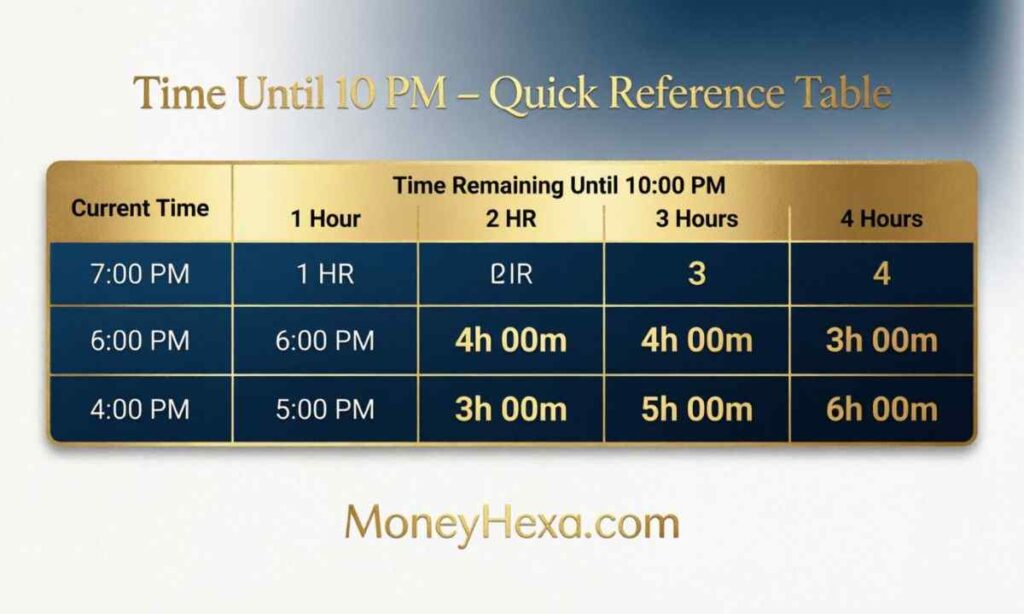
Here’s a chart covering common times people check throughout the day. Find the time closest to right now and read across.
| Current Time | Time Left Until 10 PM |
| 12:00 PM (Noon) | 10 hours |
| 1:00 PM | 9 hours |
| 2:00 PM | 8 hours |
| 3:00 PM | 7 hours |
| 4:00 PM | 6 hours |
| 5:00 PM | 5 hours |
| 6:00 PM | 4 hours |
| 7:00 PM | 3 hours |
| 8:00 PM | 2 hours |
| 9:00 PM | 1 hour |
| 9:30 PM | 30 minutes |
| 9:45 PM | 15 minutes |
| 9:55 PM | 5 minutes |
This table works for a whole hour. If your current time falls between two of these, just adjust using the minutes.
How to Calculate Time Until 10 PM Step by Step
Working out how long until 10 pm is basic subtraction once you know the trick. Here’s the process broken into simple steps.
Step 1: Convert to the Same Format
10 PM is 22:00 in 24 hours. If you’re more comfortable with 24 hour clocks, convert your current time first. For example, 6:45 PM becomes 18:45.
Step 2: Subtract the Hours
Subtract your current hour from 22 (or from 10 if you’re staying in a 12 hour format and it’s already PM). So if it’s 18:45, you get 22 minus 18, which equals 4 hours.
Step 3: Handle the Minutes
Now look at the minutes. Since 18:45 is 45 minutes past the hour, you actually have less than a full 4 hours left. Subtract those 45 minutes from your hour total.
- 4 hours minus 45 minutes equals 3 hours and 15 minutes left
Step 4: Double Check With Addition
A good way to confirm your answer is to add the time you calculated back to your starting point. If 18:45 plus 3 hours and 15 minutes equals 22:00, your math checks out.
Practical Examples of Calculating Time Until 10 PM
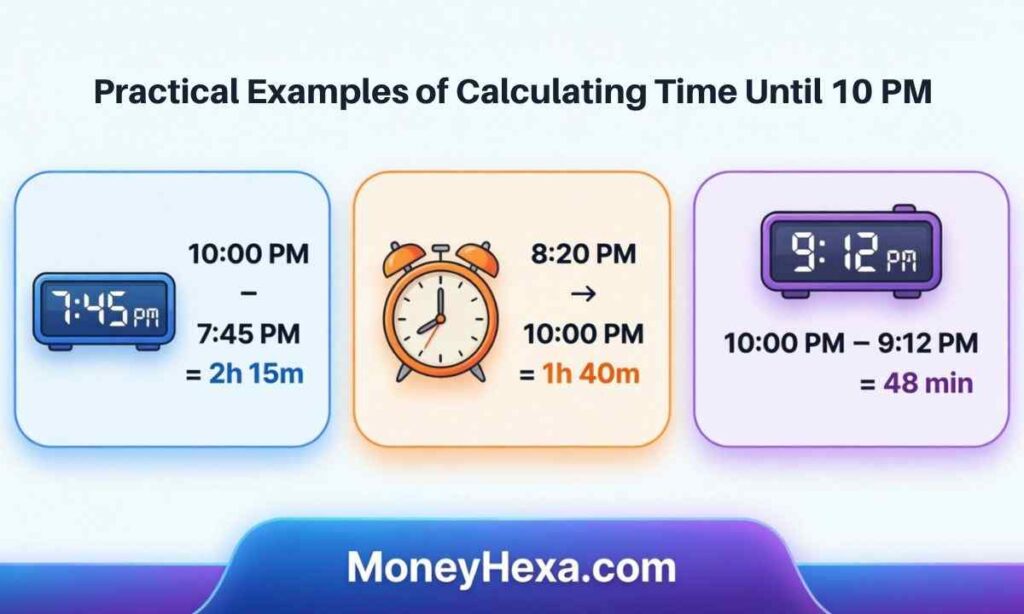
Numbers make more sense with real scenarios. Here are a few common situations people run into.
Example 1: Watching a Movie
It’s 7:20 PM and you want to know if a 2 hour movie will finish before 10 PM. You have 2 hours and 40 minutes until 10 PM, so yes, you’ll finish with 40 minutes to spare.
Example 2: Work Shift Ending
Your shift started at 2:00 PM and ends at 10:00 PM. If it’s currently 5:30 PM, you’ve worked 3 hours and 30 minutes, and you still have 4 hours and 30 minutes left on the clock.
Example 3: Bedtime Countdown
A parent checking bedtime routines at 8:40 PM for a 10 PM cutoff has 1 hour and 20 minutes left to get everything done, including baths, teeth brushing, and story time.
Time Until 10 PM From Different Starting Points
| Scenario | Start Time | Time Until 10 PM |
| Lunch break ends | 1:15 PM | 8 hours 45 minutes |
| Afternoon meeting | 3:40 PM | 6 hours 20 minutes |
| Dinner time | 6:05 PM | 3 hours 55 minutes |
| Evening walk | 7:50 PM | 2 hours 10 minutes |
| Late night snack | 9:20 PM | 40 minutes |
Common Mistakes People Make When Calculating Time
Even simple math like this trips people up sometimes. Here are the errors to watch for.
- Mixing up AM and PM, especially when converting from 24 hour time
- Forgetting to subtract minutes separately from hours, leading to a rounded but wrong answer
- Assuming 10 PM is always 10 hours after noon without checking the actual current time
- Skipping the double check step and trusting a rushed mental calculation
- Using a time zone that doesn’t match where you actually are, which throws off any countdown
Small slip ups like these are why a lot of people just grab a phone calculator or a countdown app instead of doing it by hand. Both work fine, but knowing the manual method means you’re never stuck without a signal or a working app.
Why People Search “How Long Until 10 PM”

This search shows up constantly, and it’s usually tied to a specific reason rather than idle curiosity.
- Planning bedtime for kids or pets on a schedule
- Timing a movie, game, or show to see if it ends before a cutoff
- Tracking work shifts, especially closing shifts at retail or restaurant jobs
- Curfew reminders for teens or roommates
- Counting down to a scheduled call, event, or appointment set for 10 PM
Most of these searches happen in the moment, which is exactly why a quick reference table beats a long explanation. People want the number first, the reasoning second.
Related Time Calculations You Might Need
If you found this useful, you’ll probably run into these similar questions too.
- How long until midnight
- How many hours until 9 AM tomorrow
- Time difference between two clock times
- How to convert 12 hour time to 24 hour time
- How many minutes are in a workday from clock in to clock out
Knowing the same subtraction method covered above lets you answer any of these without memorizing separate rules for each one.
You May Also Like This:
“How Long Until 2:15? A Simple Time Calculator Guide“
Conclusion
Figuring out how long until 10 pm really just comes down to subtracting your current time from 22:00, then adjusting for minutes. Once you’ve done it a few times, it becomes second nature, and the reference tables above give you a shortcut for the times you check most often.
Whether you’re timing a show, wrapping up a shift, or counting down to bedtime, you now have both the fast answer and the method behind it. Bookmark this page if you find yourself asking this question often, and feel free to share it with anyone else who’s bad at clock math.

William Johnson is a dedicated writer and measurement enthusiast at moneyhexa.com. He shares accurate, simple, and practical insights about measurements, dimensions, sizes, and everyday comparisons. With a passion for making complex topics easy to understand, William helps readers discover useful information through clear explanations, research-based content, and engaging guides designed for learners, curious minds, and everyday users.