
How Long Until 2:50? A Simple Guide to Working Out the Time Left
You glanced at the clock, saw you had somewhere to be at 2:50, and now you’re doing that mental math thing where you’re not entirely sure if you’re calculating minutes or just guessing. It happens to everyone. The question “how long until 2:50” seems simple, but the answer actually depends on one thing most people forget to check first: what time it is right now, and whether you mean 2:50 AM or 2:50 PM.
This guide walks you through exactly how to figure it out, no matter when you’re reading this or which 2:50 you’re counting down to.
Quick Answer
There’s no single fixed answer to “how long until 2:50” because it changes every second depending on your current time. But here’s the method in one line:
Subtract your current time from 2:50 (either AM or PM). If the result is negative, add 24 hours (or 12, depending on how you’re counting) to find the correct countdown.
If you tell me the current time, I can give you the exact figure. Otherwise, the table and steps below will let you work it out yourself in under 30 seconds.
Why This Question Doesn’t Have One Fixed Answer
Unlike “how many minutes in an hour” (always 60) or “how many days in a week” (always 7), a countdown to a specific clock time is relative. It moves. The gap between right now and 2:50 shrinks every minute that passes, and once 2:50 hits, the countdown resets and starts climbing toward the next occurrence of 2:50 tomorrow.
That’s the core reason this search term gets typed into Google so often, and it’s also why generic answers floating around the internet are usually wrong for the person reading them. The math is simple. The timing is the tricky part.
Step-by-Step: How to Calculate Time Until 2:50

Here’s the process broken into clear steps. Grab your phone or a clock and follow along.
Step 1: Check the current time
Look at your device or wall clock. Note both the hour and the minute, and pay attention to AM or PM.
Step 2: Decide which 2:50 you mean
This trips people up constantly. There are two options:
- 2:50 AM – early morning, right after 2:00 AM
- 2:50 PM – mid-afternoon, right after 2:00 PM
If you’re not sure which one applies, default to whichever one hasn’t happened yet today.
Step 3: Subtract current time from 2:50
Convert both times into total minutes since midnight, then subtract. This avoids confusion with the “60 minutes in an hour” carry-over.
Formula:
Target time (in minutes since midnight) − Current time (in minutes since midnight) = Minutes remaining
To convert a clock time to minutes since midnight:
(Hour × 60) + Minutes = Total minutes since midnight
Step 4: Handle negative results
If your subtraction gives you a negative number, it means 2:50 has already passed for that AM/PM cycle. Add 24 hours (1,440 minutes) to get the countdown to the next occurrence.
Step 5: Convert minutes back into hours and minutes
Divide the total minutes by 60. The whole number is your hours, and the remainder is your minutes.
Worked Examples: Real Scenarios
Let’s run through a handful of common starting points so you can see the pattern in action.
| Current Time | Target Time | Time Remaining |
| 1:00 PM | 2:50 PM | 1 hour 50 minutes |
| 2:00 PM | 2:50 PM | 50 minutes |
| 2:45 PM | 2:50 PM | 5 minutes |
| 3:00 PM | 2:50 PM (next day) | 23 hours 50 minutes |
| 9:00 AM | 2:50 PM | 5 hours 50 minutes |
| 11:30 PM | 2:50 AM (next day) | 3 hours 20 minutes |
| 12:00 AM (midnight) | 2:50 AM | 2 hours 50 minutes |
| 5:15 AM | 2:50 PM | 9 hours 35 minutes |
Notice how the countdown collapses fast once you’re within the same hour, then jumps back up to nearly a full day the moment you pass the target.
Formula Conversions: Minutes, Hours, and Decimals
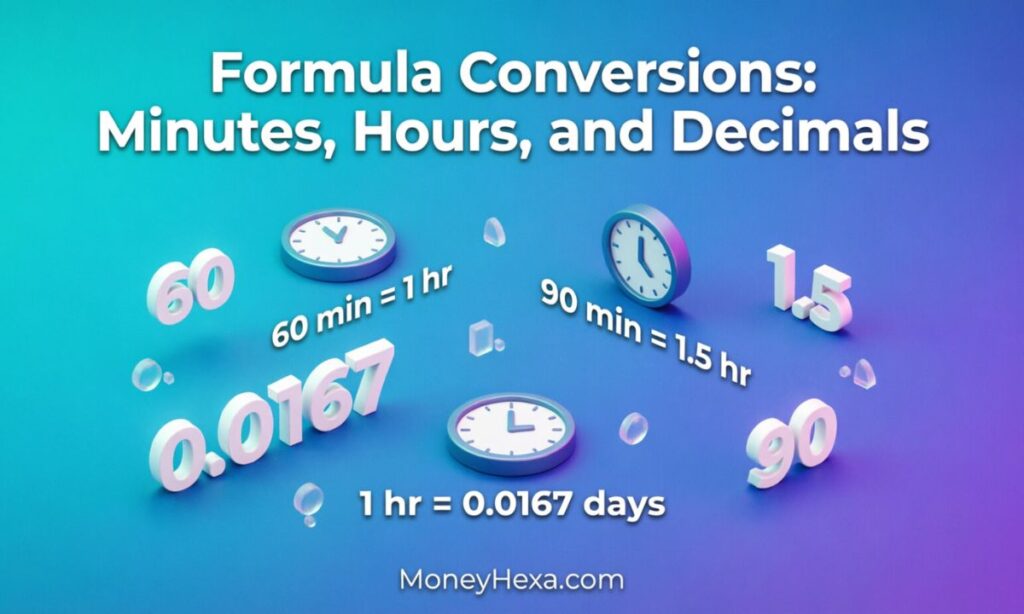
Sometimes you don’t just want “hours and minutes,” you want the number in a different format, like decimal hours for a timesheet or total seconds for a script. Here’s how those conversions work.
| Format | Conversion Method | Example (1 hr 50 min) |
| Hours & Minutes | Standard clock format | 1 hour 50 minutes |
| Decimal Hours | Minutes ÷ 60, added to whole hours | 1.83 hours |
| Total Minutes | (Hours × 60) + Minutes | 110 minutes |
| Total Seconds | Total minutes × 60 | 6,600 seconds |
This matters more than people expect. If you’re logging billable hours or setting a countdown timer in code, decimal and second-based formats save you from doing awkward manual conversions later.
Common Mistakes People Make With This Calculation
Mixing up AM and PM
This is by far the most common error. Someone checks their phone at 3:00, sees “2:50” written somewhere, and assumes it’s later today, when it’s actually already passed and they’re really counting toward tomorrow’s 2:50.
Forgetting the 24-hour wraparound
When your current time is past the target, you can’t just get a negative number and shrug. You need to add a full day’s worth of minutes to reflect that the target is now tomorrow.
Rounding too early
If you round 1 hour 49 minutes up to “about 2 hours” early in your calculation, small errors compound. Always work in exact minutes first, then round for the final answer if needed.
Ignoring time zones
If you’re coordinating with someone in a different time zone, “2:50” in their world and “2:50” in yours are not the same moment. Always clarify which time zone applies before calculating.
Confusing duration with clock time
“How long until 2:50” is a duration question. Some people accidentally answer it like it’s asking “what time is it now,” which gives a completely different (and useless) response.
Why People Search “How Long Until 2:50”
This kind of search usually comes from a very specific, immediate need rather than idle curiosity. A few common triggers:
- Waiting for an appointment – doctor visits, meetings, calls scheduled for 2:50.
- Countdown to a break or shift change – workers watching the clock toward a 2:50 finish or lunch time.
- Travel timing – a flight, train, or bus departing at 2:50 and needing to know how much buffer time is left.
- Cooking or timers – something needs to come out of the oven or finish cooking by 2:50.
- Kids and school schedules – pickup times, class periods, or bus arrivals set at 2:50.
- Streaming or event start times – a show, game, or live stream starting at 2:50 and wanting a live countdown.
Because the need is usually urgent and specific, generic articles that don’t explain the actual method (rather than just guessing a static number) don’t help much. That’s exactly why understanding the formula yourself is more useful than searching for a single fixed answer.
You May Also Like This:
“What Time Was It 17 Hours Ago?“
“What Time Was It 12 Hours Ago?“
”What Time Was It 11 Hours Ago?“
Related Calculations and Topics

If this kind of time math is useful to you, here are a few related calculations worth knowing:
- How long until midnight – useful for New Year’s countdowns or end-of-day deadlines.
- How many hours between two times – the general version of this same formula.
- Time zone conversion – critical when coordinating across regions.
- Elapsed time calculators – for tracking how long a task or event has been running.
- Countdown timers for specific dates – same logic, just extended across days instead of hours.
- Military time (24-hour clock) conversion – helpful when your current time is displayed in 24-hour format and you need to match it against a 12-hour target like 2:50.
Conclusion
“How long until 2:50” isn’t a trick question, but it does need a little context before it has a real answer. Once you know the current time and whether you’re aiming for 2:50 AM or PM, the math is just simple subtraction, with a quick adjustment if the target has already passed.
Use the steps and tables above, and you’ll never have to second-guess a countdown again, whether it’s for a meeting, a flight, or just watching the clock tick down to your lunch break.

William Johnson is a dedicated writer and measurement enthusiast at moneyhexa.com. He shares accurate, simple, and practical insights about measurements, dimensions, sizes, and everyday comparisons. With a passion for making complex topics easy to understand, William helps readers discover useful information through clear explanations, research-based content, and engaging guides designed for learners, curious minds, and everyday users.