
How Many Hours Until 12 PM Today: A Simple Time Calculation Guide
Figuring out how many hours until 12 pm today is one of those small questions that pops up more often than you’d think. Maybe you have a lunch meeting, a deadline, or you’re just watching the clock tick toward noon. Whatever the reason, getting the math right matters.
This guide walks you through the exact steps to calculate the time remaining until noon, no matter what time it is right now. You’ll also find quick reference tables, common mistakes to avoid, and answers to questions people search alongside this topic.
Quick Answer

To find out how many hours until 12 pm today, subtract your current time from 12:00 PM using a 24 hour format. If it’s currently 8:00 AM, you have 4 hours left. If it’s 3:00 PM, noon has already passed and you’re looking at tomorrow’s 12 pm instead.
The formula is simple:
12:00 (noon in 24 hour time) minus current hour equals hours remaining
Keep reading for a full breakdown, examples for every time of day, and a table you can reference instantly.
Why People Search for Hours Until Noon
This search shows up for a mix of practical reasons. Some people are tracking a countdown for work, like a shift that ends at noon or a project due right before lunch. Others are scheduling something, such as a flight, a doctor’s appointment, or a call with someone in a different time zone.
Parents sometimes search this to plan school pickups or half day schedules. Students use it to track exam start times. And plenty of folks are just curious, especially late at night when they’re wondering how many hours stand between them and the next day’s noon deadline.
Whatever brought you here, the calculation stays the same. Only the starting point changes.
Step by Step: How to Calculate Hours Until 12 PM
Here’s the process broken into clear steps.
Step 1: Check the current time
Look at a clock or your phone. Note the exact hour and minute, and whether it’s AM or PM.
Step 2: Convert to 24 hour format if needed
Noon is always 12:00 in 24 hour time. If your current time is in AM, it stays the same number (7:00 AM is 7:00). If it’s PM, add 12 to the hour, except for 12 PM itself which stays at 12:00.
Step 3: Subtract current time from 12:00
Take 12:00 and subtract your current hour and minute. Whatever is left is your answer.
Step 4: Adjust for minutes
If your current time includes minutes, you’ll need to borrow an hour to subtract properly. For example, going from 9:45 to 12:00 means you borrow, turning it into 11:60 minus 9:45, which equals 2 hours and 15 minutes.
Step 5: Check if noon already passed
If it’s already past 12:00 PM today, you’re actually counting toward tomorrow’s noon. Add 24 hours to your total and recalculate.
Example Calculation
Let’s say it’s currently 6:20 AM.
- Noon in 24 hour time is 12:00
- Subtract 6:20 from 12:00
- Borrow an hour: 11:60 minus 6:20 equals 5 hours and 40 minutes
So there are 5 hours and 40 minutes left until 12 pm today.
Hours Until Noon Reference Table
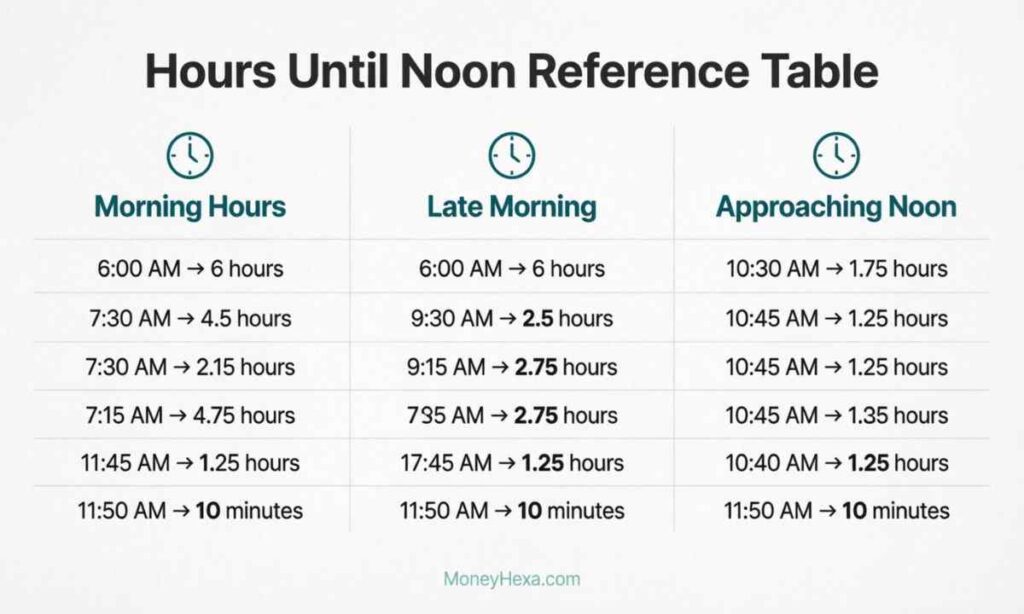
Here’s a table showing how many hours remain until noon based on common starting times.
| Current Time | Hours Until 12 PM |
| 12:00 AM | 12 hours |
| 2:00 AM | 10 hours |
| 4:00 AM | 8 hours |
| 6:00 AM | 6 hours |
| 8:00 AM | 4 hours |
| 9:00 AM | 3 hours |
| 10:00 AM | 2 hours |
| 11:00 AM | 1 hour |
| 11:30 AM | 30 minutes |
| 12:00 PM | 0 hours (it’s noon) |
This table gives you a fast look without doing the math yourself, though it’s rounded to the nearest common check in time.
What If It’s Already Past Noon?
This is where a lot of people get confused. If the current time is 2:00 PM, noon has already happened today. So the question shifts to how many hours until noon tomorrow.
Here’s how that works:
- Take the hours remaining in today (from current time to midnight)
- Add 12 hours for the stretch from midnight to noon
Example for After Noon
It’s currently 4:00 PM.
- Hours left until midnight: 8 hours
- Add 12 hours to reach noon tomorrow
- Total: 20 hours
| Current Time (PM) | Hours Until Next 12 PM |
| 1:00 PM | 23 hours |
| 3:00 PM | 21 hours |
| 5:00 PM | 19 hours |
| 7:00 PM | 17 hours |
| 9:00 PM | 15 hours |
| 11:00 PM | 13 hours |
Converting Hours Into Minutes and Seconds
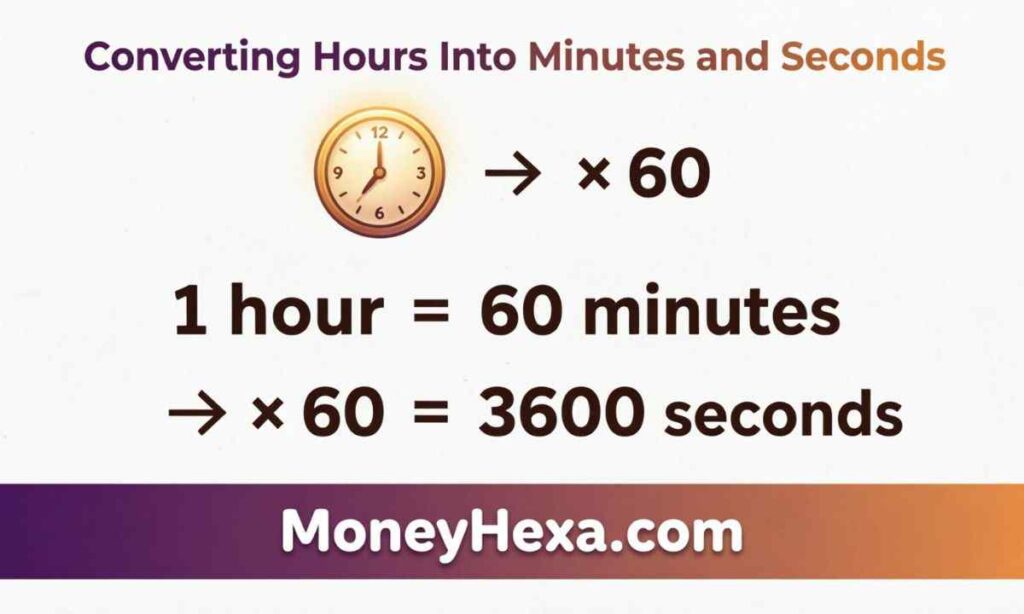
Sometimes you need the answer in smaller units, especially for a countdown timer or app.
Here’s the breakdown:
- 1 hour equals 60 minutes
- 1 hour equals 3,600 seconds
- To convert your hours until noon into minutes, multiply by 60
- To convert into seconds, multiply by 3,600
Quick Conversion Table
| Hours Until Noon | Minutes | Seconds |
| 1 hour | 60 minutes | 3,600 seconds |
| 3 hours | 180 minutes | 10,800 seconds |
| 5 hours | 300 minutes | 18,000 seconds |
| 8 hours | 480 minutes | 28,800 seconds |
| 12 hours | 720 minutes | 43,200 seconds |
This comes in handy if you’re building a countdown widget or just want a more precise number for planning purposes.
Common Mistakes People Make

A few slip ups happen often when people try to calculate this on their own.
- Mixing up AM and PM. Forgetting whether the current time is morning or afternoon throws the whole calculation off.
- Not borrowing an hour for minutes. Subtracting minutes directly without borrowing gives a negative or wrong number.
- Assuming noon already passed when it hasn’t. Double check the current time before assuming you need to calculate for tomorrow.
- Ignoring time zones. If you’re scheduling something across regions, your local noon isn’t the same as someone else’s noon.
- Rounding too early. If you round the current time before subtracting, your final answer can be off by several minutes.
Taking an extra few seconds to double check the starting time avoids most of these errors.
Practical Scenarios Where This Matters
Knowing the exact hours until 12 pm today helps in a bunch of everyday situations.
Work shifts. If your shift ends at noon, tracking the hours left helps you pace tasks and breaks.
Flight or travel bookings. Noon departures are common, and knowing exactly how much time you have left affects when you leave for the airport.
Cooking and meal prep. Recipes with long cook times, like slow roasted dishes meant to be ready by lunch, need accurate countdown math.
Fasting schedules. Intermittent fasting plans often end or begin around noon, so people track this closely.
Deadlines. School assignments, work reports, and online submissions frequently use noon as a cutoff time.
Related Calculations You Might Need
Since noon comes up in a lot of daily planning, here are a few related calculations worth knowing.
- Hours until midnight: Subtract your current time from 24:00 instead of 12:00
- Hours until 6 pm: Follow the same subtraction method, just using 18:00 in 24 hour format
- Hours between two custom times: Convert both times to 24 hour format, then subtract the earlier from the later
- Days until a future date combined with a noon deadline: Calculate full days first, then add the hours remaining until noon on the final day
These follow the exact same logic as calculating time until noon, just with a different target hour.
How to Track This Automatically
If doing this math by hand isn’t your thing, there are a few easy shortcuts.
- Most smartphones let you set a countdown timer for a specific time of day
- Search engines often show a live clock when you search your local time
- Calendar apps can create an event for noon with a reminder set for however many hours before
These tools remove the guesswork, especially if you need to check this multiple times a day.
You May Also Like These Article:
“57 Inches Long: 17 Things That Help You Picture 57 Inches Tall“
“What Weighs 1 Pound? 17 Common Things That Weigh 1 Pound“
Conclusion
Calculating how many hours until 12 pm today comes down to one simple subtraction, as long as you know the current time and whether noon has already passed.
Use the 24 hour format, borrow an hour when subtracting minutes, and double check AM versus PM before finalizing your answer. Whether you’re tracking a shift, a flight, or a deadline, this small calculation keeps your day running on schedule.

William Johnson is a dedicated writer and measurement enthusiast at moneyhexa.com. He shares accurate, simple, and practical insights about measurements, dimensions, sizes, and everyday comparisons. With a passion for making complex topics easy to understand, William helps readers discover useful information through clear explanations, research-based content, and engaging guides designed for learners, curious minds, and everyday users.