How Long Until 11 AM? A Simple Guide to Counting Down the Hours
Quick read, no fluff — if you’ve ever stared at a clock wondering exactly how much time stands between you and 11 am, this guide gives you the answer plus the math behind it.
You’ve got a meeting, a flight, a deadline, or maybe just a lunch date at 11 am, and your brain refuses to do the subtraction. That’s normal. Time math looks simple until you’re actually doing it in your head while half-awake or distracted. This post breaks down exactly how to figure out how long until 11 am from any starting point, why the calculation trips people up, and how to do it fast without a calculator.
Quick Answer

The time remaining until 11 am depends entirely on your current time. Here’s the fast version:
- If it’s currently before 11 am (same day): Subtract your current time from 11:00 am.
- If it’s currently after 11 am: You’re counting toward 11 am tomorrow, so subtract your current time from 24:00, then add 11 hours.
For example, if it’s 8:15 am, there are 2 hours and 45 minutes until 11 am. If it’s 3:30 pm, there are 19 hours and 30 minutes until 11 am tomorrow.
That’s the whole concept. Everything below just walks through the formulas, the common mix-ups, and some ready-made reference tables so you never have to do this math twice.
How to Calculate Time Until 11 AM (Step-by-Step)
Here’s the process broken into clear steps, whether you’re working in 12-hour or 24-hour format.
Step 1: Convert 11 AM to 24-Hour Time
11 am in 24-hour (military) time is simply 11:00. This makes subtraction cleaner since you don’t have to juggle am/pm labels.
Step 2: Convert Your Current Time to 24-Hour Format
If your current time is in am/pm format, convert it:
- Times from 12:00 am to 12:59 am become 00:00–00:59
- Times from 1:00 am to 11:59 am stay the same (just drop “am”)
- Times from 12:00 pm to 12:59 pm become 12:00–12:59
- Times from 1:00 pm to 11:59 pm become 13:00–23:59 (add 12)
Step 3: Subtract
If your current time is earlier than 11:00, subtract it directly:
11:00 − Current Time = Time Remaining
If your current time is later than 11:00, you’re calculating time until tomorrow’s 11 am:
(24:00 − Current Time) + 11:00 = Time Remaining
Step 4: Handle the Minutes Carefully
This is where most people slip up. You can’t just subtract minutes the way you subtract regular numbers, because a clock hour has 60 minutes, not 100. If your current minutes are higher than zero, you’ll need to “borrow” an hour.
Example: It’s 9:40 am. How long until 11:00 am?
- Hours: 11 − 9 = 2
- Minutes: 00 − 40 = negative, so borrow 1 hour from the hours column
- Now it’s 1 hour and (60 − 40) = 20 minutes
- Answer: 1 hour 20 minutes
Time Until 11 AM: Quick Reference Table (Same Day)
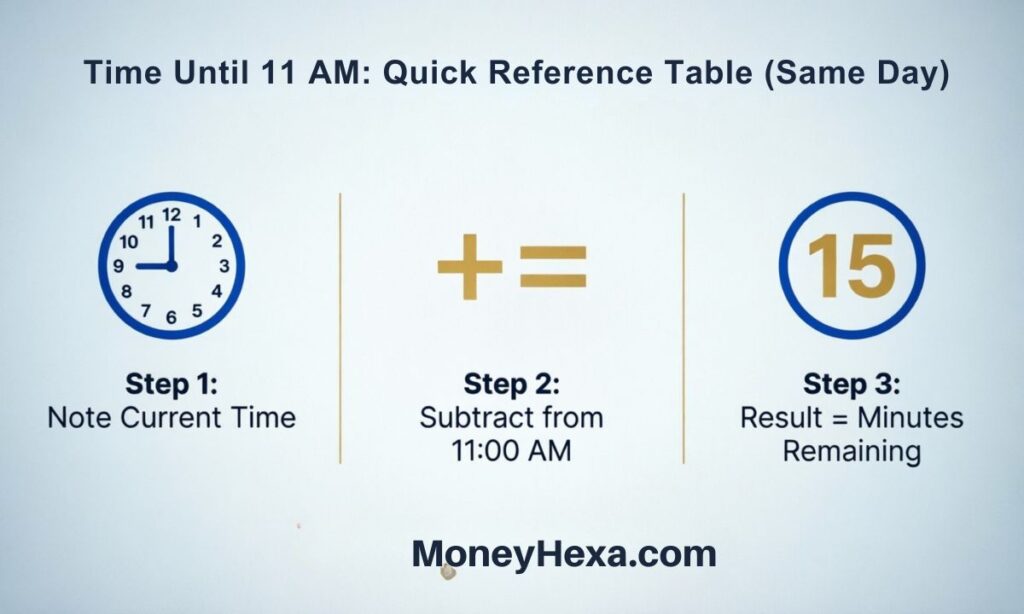
Use this table if it’s currently morning and you’re counting down to 11 am today.
| Current Time | Time Until 11 AM |
| 6:00 AM | 5 hours 0 minutes |
| 7:00 AM | 4 hours 0 minutes |
| 7:30 AM | 3 hours 30 minutes |
| 8:00 AM | 3 hours 0 minutes |
| 8:15 AM | 2 hours 45 minutes |
| 8:45 AM | 2 hours 15 minutes |
| 9:00 AM | 2 hours 0 minutes |
| 9:30 AM | 1 hour 30 minutes |
| 10:00 AM | 1 hour 0 minutes |
| 10:30 AM | 30 minutes |
| 10:45 AM | 15 minutes |
| 10:55 AM | 5 minutes |
Time Until 11 AM Tomorrow: Quick Reference Table (Afternoon/Evening)
If it’s already past 11 am, use this table to see how long until 11 am the next day.
| Current Time | Time Until 11 AM (Next Day) |
| 12:00 PM (Noon) | 23 hours 0 minutes |
| 1:00 PM | 22 hours 0 minutes |
| 3:00 PM | 20 hours 0 minutes |
| 5:00 PM | 18 hours 0 minutes |
| 7:00 PM | 16 hours 0 minutes |
| 9:00 PM | 14 hours 0 minutes |
| 11:00 PM | 12 hours 0 minutes |
| 12:00 AM (Midnight) | 11 hours 0 minutes |
| 2:00 AM | 9 hours 0 minutes |
| 4:00 AM | 7 hours 0 minutes |
Real-World Scenarios: Why the Math Matters

Numbers on a table are one thing. Here’s how this calculation actually shows up in daily life.
Scenario 1: Catching a Flight
You wake up at 5:50 am for an 11 am flight. Once you account for airport arrival time (usually 2 hours before boarding for domestic, 3 for international), your real “how long until I need to leave” window shrinks fast. Knowing you have 5 hours and 10 minutes until departure — not until boarding closes — changes how you plan your morning.
Scenario 2: A Job Interview
Interviews scheduled at 11 am are common because they land right before lunch, giving interviewers a natural reason to wrap things up. If you’re up at 6:30 am with pre-interview nerves, knowing you’ve got 4 hours and 30 minutes to prep, dress, and commute helps you pace yourself instead of rushing or over-waiting.
You May Also Like This:
“How Long Until 8PM?: A Simple Way To Work It Out Right Now“
“How Long Until 1:45? Quick Answer Plus Easy Time Calculation Guide“
Scenario 3: Cooking or Baking Timelines
Recipes that need to be “ready by 11 am” — think brunch dishes, slow-roasted meats, or dough that needs to be proof — require you to work backward from 11 am. If a roast needs 3 hours and you want it done by 11, you start at 8 am sharp.
Scenario 4: Time Zone Coordination
If you’re scheduling a call for “11 am” across time zones, the countdown isn’t just about your local clock — it’s about the recipient’s local 11 am too. This is one of the most common reasons people search for this exact phrase: they’re not confused about time itself, they’re confused about whose 11 am they mean.
Common Mistakes and Misconceptions
A few patterns show up again and again when people try to do this math manually:
- Treating minutes like decimals. People subtract 9:40 from 11:00 and get “1 hour 60 minutes” or “1.6 hours” instead of properly borrowing an hour to get 1 hour 20 minutes.
- Forgetting am/pm entirely. It’s easy to calculate the hour gap and forget whether you’re counting toward 11 am or 11 pm — two very different answers.
- Ignoring the “next day” rule. If it’s 6 pm, the countdown to 11 am isn’t negative — it’s tomorrow’s 11 am, roughly 17 hours away.
- Mixing up 12-hour clock edges. Midnight (12:00 am) and noon (12:00 pm) confuse a lot of people because “12” doesn’t follow the usual am/pm logic. Midnight is the start of the day, not the end.
- Assuming everyone means the same time zone. In virtual meetings or global teams, “11 am” without a time zone label is genuinely ambiguous and causes real scheduling errors.
Why People Search “How Long Until 11 AM”
This looks like a small, oddly specific question, but it’s searched constantly for practical reasons:
- Appointment planning — doctor visits, interviews, calls, and meetings frequently get booked for 11 am since it avoids early-morning rush and late lunch hours.
- Travel prep — flights, trains, and check-ins often list 11 am as a boarding or arrival cutoff.
- Fasting and health tracking — people doing intermittent fasting or timed medication schedules often count down to a specific hour like 11 am to close their eating or dosing window.
- Event countdowns — weddings, exams, product launches, and livestreams commonly start at 11 am, and people want a live countdown rather than doing mental math.
- Simple curiosity or urgency — sometimes it’s just someone glancing at the clock, half-panicked, trying to figure out if they have time for one more coffee.
Related Calculations and Topics

If this kind of time math is useful to you, these related calculations follow the exact same logic:
- How long until noon
- How long until midnight
- How long until 9 am / 5 pm (common work-shift boundaries)
- Hours between two times (general time-difference calculator)
- Converting 12-hour time to 24-hour time
- Time zone conversion for scheduling international meetings
- Countdown calculators for specific dates and events
The core skill is the same everywhere: convert to a single 24-hour format, subtract carefully, and borrow an hour when the minutes go negative.
Conclusion
Figuring out how long until 11 am really comes down to one clean rule: subtract your current time from 11:00 if you’re still in the morning, or add up the hours to tomorrow’s 11 am if you’ve already passed it.
Once you convert everything to 24-hour time and handle the minutes properly, the math takes seconds. Whether you’re prepping for a flight, a meeting, or just trying to time your coffee break, this simple method works every single time.

William Johnson is a dedicated writer and measurement enthusiast at moneyhexa.com. He shares accurate, simple, and practical insights about measurements, dimensions, sizes, and everyday comparisons. With a passion for making complex topics easy to understand, William helps readers discover useful information through clear explanations, research-based content, and engaging guides designed for learners, curious minds, and everyday users.