

5 Weeks From Today: What Date Is It and How Do You Calculate It?
You typed “5 weeks from today” into a search bar because you need a real answer, fast — maybe for a deadline, a due date, a lease, or a countdown to an event. No fluff, just the date and the math behind it.
Quick Answer: 5 Weeks From Today
If today is Sunday, August 30, 2026, then 5 weeks from today falls on Sunday, October 4, 2026.
That’s because 5 weeks equals exactly 35 days, and 35 divides evenly by 7 — so the day of the week never changes. Whatever day you’re counting from, you’ll land on the same day of the week, five weeks later.
| From (Today) | Days Added | Result (5 Weeks Later) | Day of Week |
| August 30, 2026 | 35 days | October 4, 2026 | Sunday |
Keep reading for the full breakdown, a step-by-step method you can use for any date, and a few tables you can bookmark for quick reference.
Why 5 Weeks Always Lands on the Same Weekday

This trips a lot of people up, so it’s worth explaining plainly. A week has 7 days. Five weeks is 5 × 7 = 35 days. Since 35 is a clean multiple of 7, there’s no leftover remainder to shift the weekday forward or backward.
Compare that to counting in months, which is messier — months don’t have a fixed number of days, so “5 months from today” wobbles depending on how many 30-day, 31-day, or 28/29-day months you cross. Weeks don’t have that problem. That consistency is exactly why “X weeks from today” calculations are so much easier than “X months from today” ones.
How to Calculate 5 Weeks From Any Date (Step-by-Step)
You don’t need a calculator app for this. Here’s the manual method:
- Start with your reference date. Write down the exact day, month, and year you’re counting from.
- Multiply the number of weeks by 7. For 5 weeks, that’s 5 × 7 = 35 days.
- Add 35 days to your starting date. Count forward on a calendar, or use simple date math if you’re comfortable with it.
- Adjust for month length. If your starting date is near the end of a month, you’ll roll into the next month (or even two months later) — just keep subtracting the days remaining in each month as you go.
- Check for a leap year. If your 35-day span crosses February 29 in a leap year, that extra day is already baked into the calendar, so a standard day-count still works — just don’t accidentally skip or double-count February 29.
- Confirm the weekday. Since 35 days is exactly 5 weeks, your result should fall on the same weekday as your starting date. If it doesn’t, you’ve made an arithmetic error somewhere — go back and recheck.
Worked Example
Let’s say you’re counting from August 30, 2026:
- August has 31 days, so from August 30, there’s 1 day left in August (August 31).
- That leaves 35 − 1 = 34 days to carry into September.
- September has 30 days, so 34 − 30 = 4 days carry into October.
- Landing date: October 4, 2026 — a Sunday, same as the starting weekday.
5 Weeks From Today: Common Reference Table
Since “today” changes depending on when you’re reading this, here’s a table showing what 5 weeks out looks like from several nearby starting points, so you can find your date or verify the pattern yourself.
| Starting Date | Day of Week | 5 Weeks Later | Day of Week |
| August 24, 2026 | Monday | September 28, 2026 | Monday |
| August 27, 2026 | Thursday | October 1, 2026 | Thursday |
| August 30, 2026 | Sunday | October 4, 2026 | Sunday |
| September 3, 2026 | Thursday | October 8, 2026 | Thursday |
| September 10, 2026 | Thursday | October 15, 2026 | Thursday |
| September 15, 2026 | Tuesday | October 20, 2026 | Tuesday |
Notice the pattern: whatever weekday you start on, that’s the weekday you end on, every single time.
Weeks-to-Days Conversion Chart
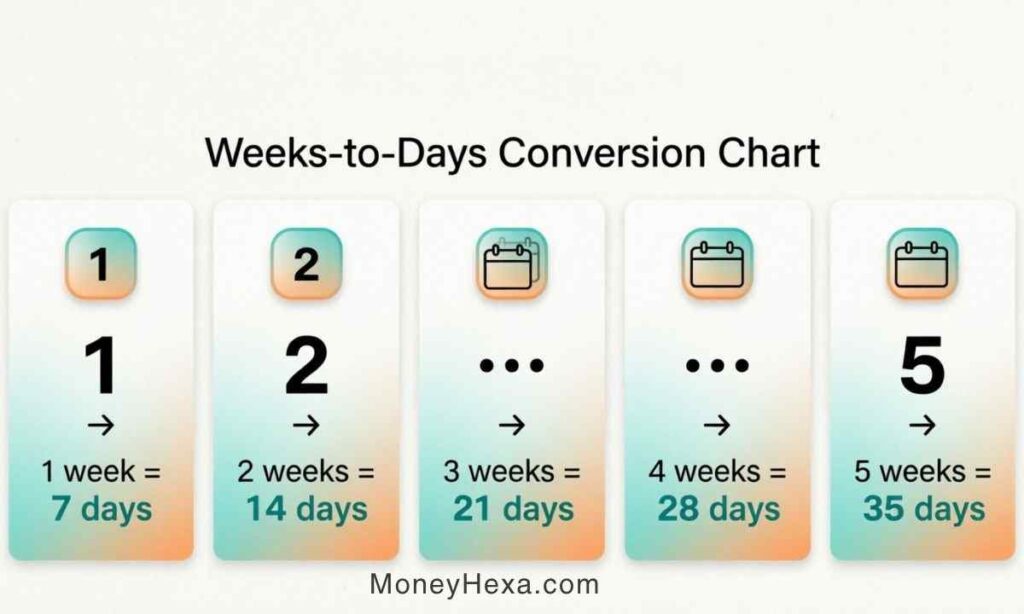
If you landed on this page but actually need a different number of weeks, here’s a quick conversion table so you don’t have to do the multiplication yourself.
| Number of Weeks | Total Days | Roughly Equal To |
| 1 week | 7 days | Just under 1/4 month |
| 2 weeks | 14 days | About half a month |
| 3 weeks | 21 days | About 3/4 month |
| 4 weeks | 28 days | Just under 1 month |
| 5 weeks | 35 days | About 1 month + 4-5 days |
| 6 weeks | 42 days | About 1.5 months |
| 8 weeks | 56 days | About 2 months |
| 10 weeks | 70 days | About 2.5 months |
Notice that 5 weeks is not the same as “one month.” It’s slightly longer, which matters a lot for anyone using this calculation for deadlines, medical appointments, or shipping estimates.
Real-World Situations Where “5 Weeks From Today” Matters
This isn’t just a trivia question. People search this for very specific, practical reasons:
- Pregnancy and medical tracking — counting forward from a specific appointment, test, or milestone.
- Project deadlines — a client says “have it ready in 5 weeks,” and you need the exact drop-dead date.
- Legal and lease notices — many notice periods (rental terminations, contract cancellations) are specified in weeks, not months.
- School terms and academic deadlines — assignment due dates, exam windows, or semester milestones.
- Fitness and training plans — many workout or diet programs are structured in 4-6 week blocks.
- Shipping and manufacturing lead times — “5-6 weeks for delivery” is a common phrase in freight, furniture, and custom-order industries.
- Event planning — save-the-dates, RSVP deadlines, and vendor payment schedules often use week-based countdowns.
You May Also Like This:
“4 Weeks From Today: Exact Date Calculator, Formula & Real-Life Uses“
“What Date Is 4 Weeks From Today?“
Common Mistakes People Make With This Calculation
A few errors show up again and again when people try to do this math by hand:
- Confusing “5 weeks” with “35 business days.” Five weeks is 35 calendar days, including weekends. If someone means working days only, that’s a completely different number (roughly 25 business days, depending on holidays).
- Rounding to “about a month.” As shown in the conversion table above, 5 weeks is longer than a calendar month by several days. Rounding down can cause you to miss a deadline.
- Forgetting to include the starting day. Some people accidentally count “today” as day 1 and end up one day off. The correct method is to add 35 full days after today’s date.
- Miscounting across month boundaries. Especially near the end of a month, it’s easy to lose track of how many days remain before rolling into the next month.
- Ignoring leap years. If your 5-week window includes February 29 in a leap year, failing to account for it (or double-counting it) throws off the final date by one day.
- Mixing up “weeks from” and “weeks ago.” Simple, but surprisingly common under deadline stress — always double-check whether you’re counting forward or backward.
Why People Search “5 Weeks From Today”

This phrase spikes for a handful of predictable reasons. Most searchers fall into one of these buckets:
- They received an instruction with a week-based timeframe (“respond within 5 weeks,” “processing takes 5 weeks”) and want the exact calendar date instead of doing mental math.
- They’re planning around a health-related timeline, such as tracking a medical follow-up or a pregnancy milestone.
- They’re setting a personal goal or challenge with a 5-week structure and want a fixed end date to work toward.
- They’re double-checking a date a colleague, contractor, or institution gave them, just to be sure nothing was miscalculated.
- They want to add the exact date to a calendar app, and typing the raw math into a search engine is faster than opening a spreadsheet.
Whatever the reason, the underlying need is the same: turn a vague timeframe into a concrete, actionable date.
Related Calculations You Might Also Need
If 5 weeks from today isn’t quite what you were looking for, here are related date calculations worth checking:
| Calculation | What It’s Used For |
| 1 week from today | Short-term reminders, quick deadlines |
| 2 weeks from today | Notice periods, bi-weekly billing cycles |
| 4 weeks from today | Common in medical and fitness tracking |
| 6 weeks from today | Postpartum checkups, longer project sprints |
| 30 days from today | Contract terms, subscription trials |
| 3 months from today | Quarterly planning, seasonal deadlines |
| 90 days from today | Legal notice periods, warranty windows |
Each of these follows the same core logic: convert the unit (weeks, days, months) into a consistent number of days, then count forward from your starting date.
Conclusion
Five weeks from today is 35 days away — and because that number divides evenly by 7, you’ll always land on the same day of the week you started on. From today, Sunday, August 30, 2026, that means the date you’re looking for is Sunday, October 4, 2026.
Whether you’re tracking a deadline, a medical milestone, or a shipping window, the math is simple once you break it down: multiply weeks by 7, add the days, and adjust for month length as you go.

William Johnson is a dedicated writer and measurement enthusiast at moneyhexa.com. He shares accurate, simple, and practical insights about measurements, dimensions, sizes, and everyday comparisons. With a passion for making complex topics easy to understand, William helps readers discover useful information through clear explanations, research-based content, and engaging guides designed for learners, curious minds, and everyday users.